Stop building toy demos. Start shipping production AI systems.
Production LLM & Agentic AIEngineering Master Program
Go deep on 37 modules covering LLM fine-tuning, agentic swarms, computer vision, AI security and LLMOps.
A hands-on 7-8 month specialization led by Mian Ahmad Basit. You will fine-tune DeepSeek-R1 and LLaMA 3.1 with QLoRA and DPO, build multi-agent systems with MCP and A2A, ship ColPali vision RAG, add NeMo security guardrails and run it all on Kubernetes.
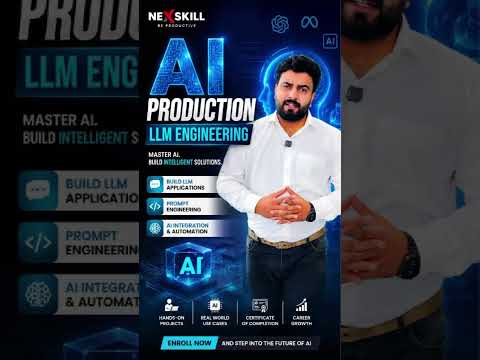
Short clips from the classroom, student projects and instructor walkthroughs.
Swipe to explore the reels. Tap any video to watch with sound.
50,000+ students trained
Join MAB Programs
Production LLM & Agentic AI Engineering
Mian Ahmad Basit
AI, Deep Learning & LLM Engineering
Mian Ahmad Basit
Stop writing bad prompt
Mian Ahmad Basit
Success story: Software Engineering with AI
Mian Ahmad Basit
Success story: Python & Agentic AI Engineer
Mian Ahmad Basit
Learn from practitioners who ship AI for a living
Technical educators and system architects guiding you from Python basics to autonomous multi-agent systems.
Lead technical trainer & curriculum architect
Mian Ahmad Basit
CEO, CTO & Lead AI Engineering Trainer
AI Engineer - GenAI - Agentic AI - Cloud
My mission is to close the gap between toy AI demos and production-grade engineering. As CTO at Pakistan Blockchain Institute and Anz Technologies, founder of P2P Clouds, and mentor to 50,000+ engineers, I guide developers step by step: from Python, linear algebra and PyTorch to fine-tuning LLaMA and DeepSeek, building agentic RAG graphs with LangGraph, mastering MCP and A2A, and deploying secure multi-tenant agent systems on the cloud.
Understand the complete model lifecycle from pre-training and continued pre-training through instruction tuning and synthetic dataset engineering.
Training Lifecycle
Pre-training vs post-training
Base model capabilities
Base model limitations
Causal Language Modeling
Masked Language Modeling
Prefix Language Modeling
Continued Pre-Training
Domain adaptation
Compute budget tradeoffs
When CPT is appropriate
Multi-Token Prediction
Data Preparation
CommonCrawl
RefinedWeb
Instruction-pair datasets
Chat-format datasets
ChatML templates
LLaMA-3 chat format
Mistral formatting
Loss masking
Dataset deduplication
Filtering pipelines
Synthetic Data
Self-Instruct
Alpaca-style datasets
Synthetic instruction generation
Data quality filtering
Key outcome
Engineer high-quality datasets and understand exactly where CPT, SFT and synthetic data fit into the model lifecycle.
Master adapter-based fine-tuning techniques and the mathematics behind low-rank adaptation and quantized training.
PEFT Mathematics
Intrinsic dimensionality
LoRA mathematics
W = W0 + BA
Rank selection
Alpha scaling
QLoRA
NF4 quantization
Double quantization
Paged optimizers
DoRA
Magnitude and direction decomposition
AdaLoRA
Adaptive rank allocation
LoRA+
Separate A/B learning rates
Supervised Fine-Tuning
SFT pipeline design
Instruction tuning
FLAN datasets
Alpaca datasets
OpenHermes datasets
Chat fine-tuning
Conversational fine-tuning
Reasoning fine-tuning
Domain-specific fine-tuning
Key outcome
Fine-tune an open-weight LLM efficiently using QLoRA and production-grade SFT datasets.
Master modern post-training methods for aligning language models with human and programmatic preferences while preparing models for efficient deployment.
Preference Alignment
Why SFT alone is insufficient
Distribution shift
Verbosity bias
RLHF
PPO
Reward models
Critic networks
KL penalties
DPO
GRPO
ORPO
Quantization & Inference Preparation
GPTQ
AWQ
BNB NF4
FP8
LoRA adapter merging
Multi-LoRA serving
vLLM
SGLang
GGUF
GGUML
llama.cpp
Speculative decoding
Training Tooling
Hugging Face TRL
SFTTrainer
DPOTrainer
GRPOTrainer
ORPOTrainer
Unsloth
Axolotl
LLaMA-Factory
Together AI
AWS SageMaker fine-tuning
Synthetic Preference Data
Instruction synthetic data
Preference synthetic data
Code synthetic data
LLM-as-Judge scoring
distilabel
DataDreamer
Argilla
Model collapse risks
Data poisoning prevention
End-to-end SFT dataset pipeline
Key outcome
Align, quantize and prepare an open-weight LLM for efficient production inference.
Phase 5Week 17 · 2 modules
Mixture of Experts & Reasoning Models
Mixture of Experts (MoE) routing mechanisms, DeepSeek-R1-Zero reasoning models and chain-of-thought reinforcement learning.
Understand sparse expert architectures used by modern production models.
Mixture of Experts
Dense-model scaling limitations
Sparse expert activation
Gating networks
Top-K routing
Router mathematics
Load-balancing loss
Auxiliary losses
Expert capacity
MoE training at scale
MoE inference
Memory vs compute tradeoffs
Mixtral 8x7B
DeepSeek-V3 256 experts
Production MoE models
MoE vs dense architectures
Key outcome
Explain how sparse expert routing enables larger models without proportional compute cost.
Understand reinforcement-learning approaches used by modern reasoning models.
Reasoning Models
Reasoning model concept
System 1 vs System 2
Chain-of-Thought
Pure RL reasoning
SFT + RL reasoning
DeepSeek-R1-Zero
Rule-based rewards
GRPO reasoning
Reasoning trace distillation
Key outcome
Explain how reinforcement learning produces modern reasoning-capable models.
Phase 6Week 18 · 2 modules
Knowledge Distillation & Small Language Models
SLM design philosophy, Liquid Foundation Models, soft labels, KL divergence and student-teacher pipeline construction.
Explore SLM design philosophy, edge deployment and training/fine-tuning of small models.
Small Language Models
SLM design philosophy
Phi-3
Gemma-2B
LLaMA-3.2-1B
Latency optimization
Privacy advantages
Edge deployment
Data density
Liquid Foundation Models
Dynamical systems
Training SLMs from scratch
SLM fine-tuning
Reasoning trace distillation
SLM vs LLM tradeoffs
Key outcome
Design and deploy compact, edge-ready small language models.
Compress foundation-model capabilities into smaller student models.
Knowledge Distillation
Teacher-student paradigm
Hard labels
Soft labels
Temperature scaling
KL divergence
Attention transfer
Hidden-state matching
Teacher logit generation
Student architecture design
Student training pipeline
Key outcome
Build a teacher-student distillation pipeline that compresses a large model into a compact one.
Phase 7Week 19 · 2 modules
Multimodal Vision Systems & Image Understanding
Vision Transformers (ViT), CLIP, SigLIP, DINOv2 and Visual Language Models (VLMs) like LLaVA and Qwen-2-VL.
Bridge from CNNs to Vision Transformers and modern visual encoders.
Vision Transformers
CNN-to-ViT conceptual bridge
ViT architecture
16x16 image patches
Patch embeddings
CLS token
2D positional encoding
Visual self-attention
Attention maps
CNN vs ViT inductive bias
CLIP
SigLIP
DINO
DINOv2
Key outcome
Implement and reason about Vision Transformer patch embeddings and self-attention.
Understand how visual encoders connect to LLM backbones to produce multimodal reasoning.
Visual Language Models
VLM architecture
LLaVA
Qwen-2-VL
Gemini Vision
Visual encoder
ViT/SigLIP encoders
MLP projectors
Cross-attention aligners
Perceiver alignment
Vision-language feature spaces
Visual grounding
Key outcome
Explain and build the encoder-projector-LLM pipeline behind modern VLMs.
Understand speech signal processing and build custom speech-to-text pipelines with Whisper.
Speech AI
Speech signal processing
Log-Mel spectrograms
Speech-to-Text
Whisper API
Whisper architecture
Audio Encoder-Decoder Transformer
Streaming chunking
Audio dataset preparation
Whisper fine-tuning
Domain accents
Domain-specific audio
Key outcome
Fine-tune Whisper on domain-specific audio and build streaming speech-to-text systems.
Phase 9Week 21 · 1 module
Representation Learning & Embedding Systems
Dense, sparse, quantized, binary and multi-vector (ColBERT) embeddings, Matryoshka Representation Learning (MRL) and embedding fine-tuning.
Understand modern embedding architectures from dense vectors through sparse lexical signals, quantized representations, ColBERT multi-vectors and Matryoshka embeddings.
Embedding Taxonomy
Dense embeddings
BGE
E5
OpenAI text-embedding models
Sparse embeddings
SPLADE
BM25
Quantized embeddings
Float32 to Int8
Uint8 compression
Binary embeddings
Hamming distance
Multi-vector embeddings
ColBERT
ColPali
Matryoshka Representation Learning
MRL concept
Flexible embedding dimensions
Nested dimension loss
1536 to 256 dimension retrieval
Dynamic query-time dimensions
Embedding Fine-Tuning & Evaluation
Multiple Negatives Ranking Loss
Embedding fine-tuning
Domain adaptation
MTEB benchmark
Embedding leaderboard analysis
State-of-the-art embedding evaluation
Key outcome
Select, fine-tune, compress and benchmark embeddings for enterprise retrieval workloads.
Agent benchmarking, cost analysis and execution tracking.
LangSmith
Core
Full-suite tracing, debugging and testing platform.
Opik
Open-source LLM evaluation and monitoring engine.
Langfuse
Core
Open-source observability, prompt management and analytics.
Logfire
Core
Span-level telemetry from the Pydantic team.
Core AI Concepts
11
RAG
Core
Retrieval Augmented Generation for external knowledge grounding.
Agentic RAG
Core
Agent-driven dynamic search, self-correction and synthesis.
Context Engineering
Core
Optimizing context windows, pruning and memory layout.
Prompt Engineering
Core
CoT, few-shot and structured prompt optimization.
Pydantic
Core
Data validation and typed schemas for LLM contracts.
Vector DBs (Qdrant/Pinecone)
Core
High-speed vector similarity indices.
Agent Evaluation (Inspect AI)
Core
Task, solver and scorer evaluation harnesses.
Agent Security & RBAC
Core
Multi-tenant isolation, prompt defense and JWT RBAC.
Guardrails (NeMo / Presidio)
Core
Input/output scanners, toxicity filters and PII masking.
FAISS
Facebook AI Similarity Search vector library.
Tavily
Core
Search API optimized for LLM agent research loops.
Deployment & Web UI
7
Docker
Core
Multi-stage containerization for reproducible builds.
GitHub Actions
Core
Automated CI/CD workflows for testing and deployment.
FastAPI
Core
High-performance Python web framework for async AI APIs.
BentoML
Unified framework for serving and packaging ML models.
Nginx
High-performance reverse proxy and SSL termination.
Streamlit
Core
Rapid Python web UI prototyping for data and AI.
Gradio
Interactive Python interfaces for machine learning models.
Cloud Infrastructure
4
AWS (EKS / Bedrock / Lambda)
Core
Amazon Web Services cloud suite for AI workloads.
GCP (Vertex AI / Cloud Run / GKE)
Core
Google Cloud Platform AI and serverless containers.
Azure (Azure OpenAI / AI Foundry)
Core
Microsoft Azure enterprise cloud platform.
Self-Hosted VPS
Core
Bare-metal and private virtual servers for cost efficiency.
Model Providers & Inference
7
OpenAI (GPT-4o / o3-mini)
Core
Frontier models and structured output endpoints.
Anthropic (Claude 3.5 Sonnet)
Core
High intelligence reasoning and coding models.
Google Gemini (1.5 Pro / Flash)
Core
Multimodal 2M+ token context window models.
Groq
Core
Ultra-fast LPU inference engine for open-source LLMs.
Ollama
Core
Local LLM runner for LLaMA-3, DeepSeek-R1 and Phi-3.
AWS Bedrock
Core
Managed foundation models on Amazon Web Services.
Azure OpenAI
Core
Enterprise-grade managed OpenAI endpoints on Azure.
Career scope and earning potential
AI engineering is one of the most in-demand technical skill sets. These ranges show what skilled engineers can charge.
Full-time jobs
Global AI engineer salary
$120K - $250K / yr
Top remote positions across US, UK, EU and UAE companies seeking specialized agentic and RAG engineers.
Upwork & LinkedIn
Remote consulting rate
$80 - $250 / hr
High-ticket hourly rates for custom DeepSeek fine-tuning, vector database optimization and agent setups.
Per-project contracts
Enterprise AI agency retainer
$5,000 - $25,000
Building multi-tenant AI SaaS, self-hosted n8n automation and confidential enterprise RAG pipelines.
Freelancing income estimator
Estimate your monthly revenue from part-time remote consulting.
$120/hr
$50 junior$250 architect
15hrs/wk
5 hrs side hustle40 hrs full-time
Estimated monthly earnings
$7,200/ month
About $86,400 per year from part-time remote consulting.
Illustrative market ranges, not income guarantees. Your results depend on your skills, portfolio and effort.
Student bonuses and career accelerator toolkit
Beyond the technical curriculum, enrollment includes career placement support, freelancing frameworks, LMS access and direct mentorship.
Hands-on practical projects
Production repos & full codebases
Zero fluff or toy demos. You build production-grade, containerized LLM and agent systems on AWS, GCP and Kubernetes.
Production GitHub repositories with complete test suites
Dockerized FastAPI microservices and Helm charts
DeepSeek-R1 and LLaMA 3.1 QLoRA/DPO fine-tuning notebooks
ColPali VLM multimodal RAG and Neo4j knowledge graph setups
Included in the program
LMS recorded lectures
2 years of LMS portal access
Never miss a single insight. Revisit HD class recordings, code repositories and slide decks anytime for 24 months.
Searchable HD session recordings with timestamps
Downloadable Jupyter notebooks and architecture PDF blueprints
Interactive module quizzes and self-assessment benchmarks
Quarterly content updates on new AI breakthroughs
Included in the program
Internship opportunities
AI engineering internships & career growth
Fast-track your career with internship referrals at partner organizations, Pakistan Blockchain Institute and Anz Technologies.
Internship placement path for top program performers
Official verified certificate of completion from the instructor
1-on-1 portfolio and GitHub profile review by Mian Ahmad Basit
Mock technical interviews for AI engineer and LLMOps roles
Included in the program
Freelancing & business development
AI agency & freelance business playbook
Learn how to monetize your skills, win high-ticket $5,000-$25,000 AI consulting clients and launch scalable AI SaaS products.
Proven Upwork and LinkedIn client acquisition scripts
Enterprise AI architecture proposal and scope templates
Pricing models for custom LLM fine-tuning and agentic automation
Building multi-tenant AI SaaS/BaaS products from scratch
Included in the program
Direct guidance by Mian Ahmad Basit
CTO @ Pakistan Blockchain Institute & Anz Technologies, founder of P2P Clouds
“I review code repos, guide business pitches and personally mentor candidates aiming for senior AI roles.”
Where do you stand in your AI journey?
Answer 3 quick questions to find your personalized entry point.
Question 1 of 3
0% complete
What is your current background in Python and programming?
Frequently asked questions
Clear answers about the program structure, prerequisites, tools and support.
Python developers, software engineers, AI/ML engineers, data scientists, full-stack developers and technical professionals moving into modern production AI.
If you want to move beyond surface-level prompting and build production-grade agentic systems, fine-tuned LLMs and cloud-native AI pipelines, this program is designed for you.
The lead instructor is Mian Ahmad Basit, supported by experienced engineers from the faculty.
No. The roadmap starts with Python, math, ML, deep learning and NLP foundations before moving into transformers, LLM fine-tuning, RAG, agents, security and cloud deployment.
Yes. The program focuses on production Python, FastAPI services, Dockerized systems, vector databases, agent orchestration, guardrails, observability and cloud deployment patterns.
OpenAI GPT-4o and o-series models, Claude 3.5 Sonnet, DeepSeek-R1 and V3, Meta LLaMA 3.1/3.3, Google Gemini, Hugging Face models, Ollama and vLLM.
Yes. The curriculum includes LangGraph, PydanticAI, MCP, A2A protocols, tool calling, supervisor agents, state checkpointing, human-in-the-loop workflows and agent observability.
Build the future of AI, one system at a time
Go beyond prompting.
Learn how modern AI systems are designed, trained, fine-tuned, retrieved, orchestrated, evaluated, secured and deployed, with lead mentor Mian Ahmad Basit.
Get 10% off the Master Cohort
--Hrs
--Min
--Sec
Enroll before the timer ends and mention the code in your application. Code: MASTER10